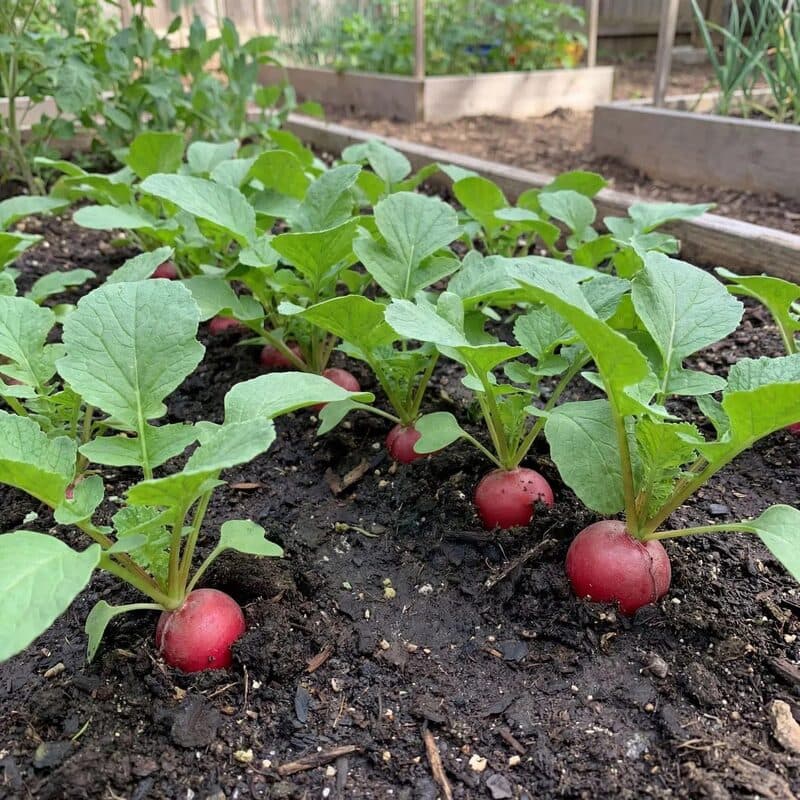
Why This Is Easy
One of the fastest confidence crops: quick sprouting and a very fast harvest cycle.
Simple care: direct sow, keep moisture steady, and harvest on time.
Planting Specs (Depth + Spacing)
- Depth: ½ inch
- Spacing / thinning: Sow closely, then thin to 1–2 inches apart
Timeline (What to Expect)
- Sprout window: 3–7 days
- When to thin: As soon as seedlings are about 1–2 inches tall (don’t delay)
- Harvest window: 21–30 days (harvest promptly for best texture and mild flavor)
When to Plant
Radishes are a cool-weather crop.
Best results usually come in spring and again as temperatures cool.
In warm weather, radishes become spicy faster and turn pithy if left too long.
How to Plant
Direct sowing is standard—radishes do not transplant well.
Choose a sunny spot with well-draining soil.
Loosen and smooth the soil surface so seedlings can emerge easily.
Scatter seeds lightly, cover to the proper depth, and gently press the soil for good contact.
For a steadier harvest:
Plant small amounts at intervals instead of all at once.
If sprouts are patchy:
Don’t panic.
Re-sow seeds in empty gaps and keep the surface evenly moist so new seedlings can catch up.
Care Made Simple
Watering Logic Radishes perform best with fast, steady growth.
Check-first watering:
If soil feels dry → Water
If damp → Wait
If soggy → Stop and let it dry
Steady moisture keeps roots crisp and prevents cracking or pithiness.
Sun & Shade
Choose a sunny location.
In warm conditions, radishes become spicy more quickly and lose quality if harvest is delayed.
Feeding (if applicable)
Keep weeds controlled—radishes dislike competition.
Avoid heavy nitrogen feeding, which encourages leaves instead of roots. Compost mixed into the soil is usually sufficient.
Harvest
Harvest timing matters more for radishes than almost any other root crop.
Check early and harvest as soon as roots reach a usable size.
Waiting too long leads to pithy texture and stronger heat.
Pull gently; loosen firm soil first to avoid snapping roots.
For ongoing harvests:
Plant in small batches and harvest each batch on time.
Common Problems + Quick Fixes
Pithy, spongy, or overly hot roots:
Usually caused by heat stress or late harvest.
Fix: Harvest earlier, keep moisture steady, and grow in cooler weather.
Cracking roots:
Often from moisture swings (very dry followed by very wet).
Fix: Use check-first watering and avoid extreme swings.
Lots of leaves, tiny roots:
Common causes are crowding and excess nitrogen.
Fix: Thin properly and keep feeding light.
Flea beetle “shot holes” in leaves:
Small round holes in foliage.
Fix: Rinse leaves with water or use light netting to prevent insect access.
Patchy sprouts:
Often from dry surface soil, crusting, or uneven moisture.
Fix: Keep the surface evenly moist and gently loosen crusted soil so sprouts can emerge.
Quick Tips
- Direct sow and keep the soil surface moist until sprouts are clearly up.
- Thin early so roots have space to form.
- Harvest on time—waiting “just a bit longer” leads to pithy radishes.
- In warming weather, harvest earlier rather than aiming for maximum size.
Mini Checklist
- Direct sow seeds (no transplanting)
- Cover at the correct depth and press soil gently
- Use check-first watering (dry = water, damp = wait, soggy = stop)
- Thin seedlings so roots have room
- Keep weeds controlled while plants are small
- Watch for flea beetle damage and use light cover if needed
- Harvest promptly for crisp, mild radishes
[#toc](Back to TOC)Plant Profile