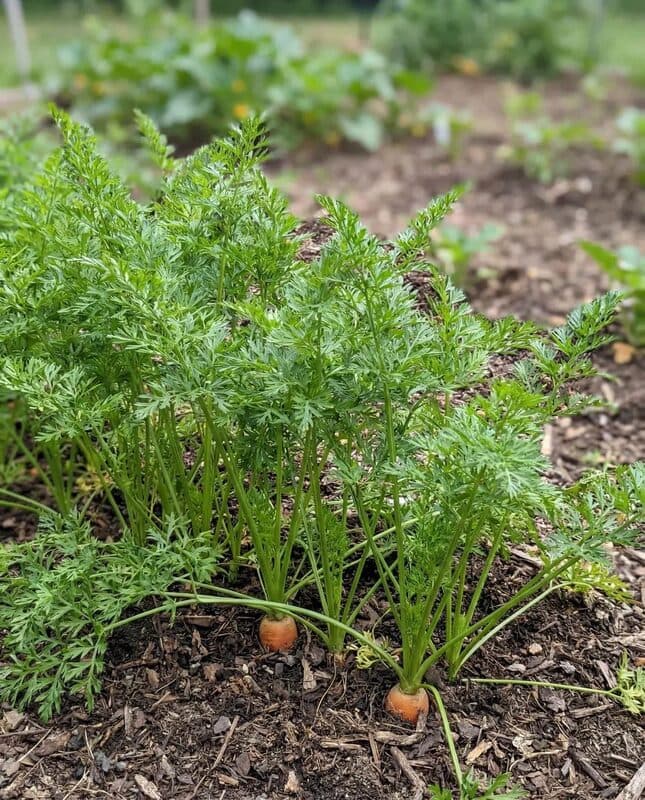
Why This Is Easy
Low maintenance after sprouting: Once carrots are up, they require very little hands-on care—no staking, pruning, or training.
Reliable variety: Scarlet Nantes is a classic, dependable type that performs well for beginners and is well suited for fresh eating.
Planting Specs (Depth + Spacing)
- Depth: About 1/4 inch (cover lightly)
- Spacing / thinning: Thin to 2–3 inches apart (closer spacing produces smaller carrots; wider spacing produces thicker roots)
Timeline (What to Expect)
- Sprout window: 7–21 days
- When to thin: When seedlings are 1–2 inches tall (thin in stages if needed)
- First harvest (baby carrots): 50–60 days
- Full-size harvest: 65–75 days
When to Plant
Carrots are a cool-season crop but grow well across much of the year. Plant in spring around your last frost window once soil is workable, and plant again for fall so roots develop as temperatures cool. Carrots tend to taste best when they grow steadily without heat stress.
How to Plant
Carrots are best direct sown. They dislike root disturbance, so avoiding transplanting leads to straighter roots and fewer problems.
Choose a location with good sun and decent drainage.
Prepare soil so it is loose and free of stones—this matters more for carrots than almost any other crop.
Break up clumps, remove rocks, and smooth the surface so seeds sit evenly.
Sprinkle seeds thinly in a shallow line, then cover lightly.
Gently press the soil for seed-to-soil contact without packing it down.
Important: Carrot seeds are small and slow to germinate. Keep the top layer of soil evenly moist until seedlings emerge.
Care Made Simple
Watering Logic Carrots need minimal watering once established, but consistency is critical early.
Check-first watering:
If soil feels dry → Water
If damp → Wait
If soggy → Stop and allow soil to dry Focus on preventing surface crusting while seeds are sprouting, as a dry crust can block seedlings.
Sun & Shade
Feeding (if applicable)
Keep the bed lightly weeded. Young carrots grow slowly at first and are easily outcompeted.
Avoid heavy feeding. Excess fertilizer promotes leafy tops rather than smooth roots. Compost mixed into the soil is usually sufficient.
Harvest (Keep It Producing)
Carrots do not regrow after pulling, but staggered harvesting extends the harvest period.
Pull baby carrots early, often starting with those removed during thinning.
Leave remaining carrots in the ground to continue sizing up.
If soil is firm, loosen gently before pulling to prevent snapping roots. Carrots do not need to be harvested all at once and can remain in the ground for a period, especially in cool weather.
Common Problems + Quick Fixes
Poor germination (nothing coming up):
Carrot germination can be slow—be patient.
Keep the soil surface evenly moist, not soggy.
If a crust forms, gently break the surface without digging deeply.
If repeated drying occurred, reseed a small section and maintain consistent moisture.
Forked or misshapen roots:
Usually caused by rocks, hard clods, or compacted soil.
Improve soil preparation and avoid disturbing roots once seedlings are growing.
Splitting roots:
Often caused by moisture swings from very dry to very wet conditions.
Use check-first watering to maintain steadier moisture.
Crowding / thin carrots:
Crowded roots compete underground and remain narrow.
Thin gently by snipping extras at soil level or pulling the smallest when soil is damp to reduce disturbance.
Think in terms of space for the root, not the leaves.
Pests (beginner-safe approach):
Inspect plants closely if foliage appears weak or damaged.
Use light netting or mesh to reduce insect pressure.
Keep the bed clean and weeded to limit pest hiding spots.
Quick Tips
- Always direct sow—carrots do not transplant well.
- Keep the soil surface evenly moist until sprouts are clearly established.
- Thinning directly improves final root size.
- As warm weather approaches, harvest earlier rather than waiting for maximum size.
Mini Checklist
- Soil loosened thoroughly and cleared of rocks and clods
- Seeds direct sown at proper depth and covered lightly
- Soil surface kept consistently moist during germination
- Surface crusting monitored and gently broken if needed
- Seedlings thinned to give roots room to form
- Weeds controlled while carrots are small
- Harvested in stages: baby carrots first, full-size later
[#toc](Back to TOC)Plant Profile